
For fixed-income investors seeking to put their money into assets that can bring benefits to less well-off people and communities, social bonds and sustainability bonds can offer effective solutions, write Malika Takhtayeva and Xuan Sheng Ou Yong.
To be clear on the distinction between social and sustainability bonds, social bonds raise money for projects, assets or activities that benefit individuals and societies. These include access to essential services such as healthcare and education, affordable housing and basic infrastructure, creating jobs, food security and socioeconomic advancement and empowerment.
Sustainability bonds raise money for both social and environmental projects, assets and activities through a single bond.
We should note that investors can expect to earn the same or similar return on both types of bonds as on similar conventional bonds. Their attraction lies in the added positive environmental and social benefits these bonds provide; in other words, we believe there is no case of doing good costing investors.
Issuance volumes stable despite global uncertainty
Issuance of social bonds grew steadily in the first three years after 2017, and then increased nearly 10-fold after the Covid-19 pandemic spread. Governments, development banks, agencies and companies used the social bond format to help finance social projects in the face of the pandemic and its associated expenditures, as well as the subsequent recovery.
Issuance volumes of social and sustainability bonds held steady at around EUR 300 billion in 2022 and 2023 (see Exhibit 1). We see it as reassuring that issuance remained stable despite the uncertainties of the aftermath of the pandemic, and the geopolitical conflicts in Ukraine and the Middle East.
The steady level of issuance also flew in the face of interest-rate volatility. The 20-year average of the MOVE index, which measures US bond market volatility, was 85.8 points; in 2023, it rose to 118 points.
For us, this indicated the continued conviction of issuers, investors, bond structurers and other parts of the financial ecosystem in the social and sustainability bond format within issuers’ bond issuance plans.
Unlike green projects, assets and activities, social projects are harder to identify in issuers’ operating models. For example, a steel manufacturer is likely to have fewer large social projects to fund compared to a development bank whose mandate is to improve outcomes for society.

How we assess the ‘social-ness’ of social bonds
The European Union Platform for Sustainable Finance published a draft social taxonomy in July 2021 to help assess the degree of ‘social-ness’ of a social bond’s proceeds. While this should help identify which activities can be seen as contributing substantially to social objectives, it has no measures to determine the extent of the contribution of each activity towards such objectives. So far, the taxonomy remains in draft form and there are no clear timelines as to when it will be formalised as a regulation.
At BNPP AM, we have developed our own social bond assessment methodology as we believe social bonds should be differentiated in terms of ambition, specificity and integrity.
- ‘Ambition’ is about the issuer’s determination to contribute towards particular social objectives and how it intends to develop its activities to address those objectives
- ‘Specificity’ concerns the identification of precise target populations and the social hardships they face, which the issuer intends to mitigate with the proceeds
- ‘Integrity’ is about the processes and management systems governing the use of the proceeds of the bond, mitigating potential risks from the associated projects and measuring and reporting on the social bond programme.
The level of recommendation we give to each social (and sustainability) bond that we assess can be positive – when the bond exceeds our minimum expectations; neutral – when the bond simply achieves what we expect of it; and negative, when the bond falls below our expectations. More details of our approach to assessing social bonds can be found in our Social Bond Methodology.
Understanding the impact
Our latest social bond impact report provides details of our analysis of the performance of almost 580 social and sustainability bonds in terms of their actual use of proceeds, the allocation across use-of-proceeds categories and the related positive impacts that resulted.
The information is split by region, type of social and environmental category, which UN Sustainable Development Goals (SDGs) were being targeted and the impact results of the social or environmental activities financed. The social and environmental use-of-proceeds categories we use are listed in Exhibit 2.
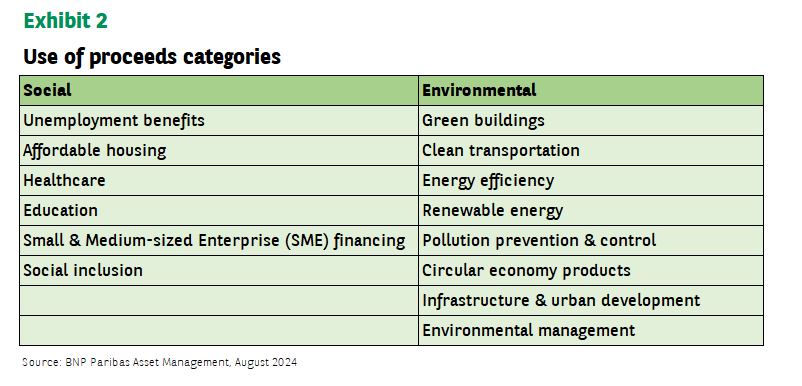
Our impact report also provides numerous examples of the effectiveness of particular social bonds issued by a range of sovereign and corporate issuers in Europe and around the world. The social projects funded by such bonds have led, for example, to reducing poverty by granting unemployment benefits, providing access to education to low-income households, and helping low-income households secure a home via social and affordable housing projects.
The report also includes examples of engagement with social bond issuers, a valuable process in terms of building a direct understanding the social objectives and challenges involved.
Disclaimer
This material is issued and has been prepared by BNP PARIBAS ASSET MANAGEMENT UK Limited (“BNPPAM UK”). Registered in England No: 02474627, registered office: 5 Aldermanbury Square, London, England, EC2V 7BP, United Kingdom. BNPPAM UK is regulated by the FCA under UK laws, which differ from Australian laws. In Australia, BNPPAM UK is exempt from the requirement to hold an Australian financial services license under the Corporations Act 2001 in respect of the financial services. This material is distributed in Australia by BNP PARIBAS ASSET MANAGEMENT Australia Limited ABN 78 008 576 449, AFSL 223418. This material is produced for information purposes only and does not constitute:
an offer to buy nor a solicitation to sell, nor shall it form the basis of or be relied upon in connection with any contract or commitment whatsoever or
investment advice.
Opinions included in this material constitute the judgement of BNPP AMAU at the time specified and may be subject to change without notice. BNPP AMAU is not obliged to update or alter the information or opinions contained within this material. Investors should consult their own legal and tax advisors in respect of legal, accounting, domicile and tax advice prior to investing in the financial instrument(s) in order to make an independent determination of the suitability and consequences of an investment therein, if permitted. Please note that different types of investments, if contained within this material, involve varying degrees of risk and there can be no assurance that any specific investment may either be suitable, appropriate or profitable for an investor’s investment portfolio.
Given the economic and market risks, there can be no assurance that the financial instrument(s) will achieve its/their investment objectives. Returns may be affected by, amongst other things, investment strategies or objectives of the financial instrument(s) and material market and economic conditions, including interest rates, market terms and general market conditions. The different strategies applied to the financial instruments may have a significant effect on the results portrayed in this material. Past performance is not a guide to future performance and the value of the investments in financial instrument(s) may go down as well as up. Investors may not get back the amount they originally invested. The performance date, as applicable, reflected in this material, does not take into account the commissions, costs incurred on the issue and redemption and taxes. All information referred to in the present material is available on www.bnpparibas-am.com.


