
By Andrew Etherington, Head of Institutional Multi-Asset Total Return
These are the core investment decisions from this month’s report on our multi-asset investment views.
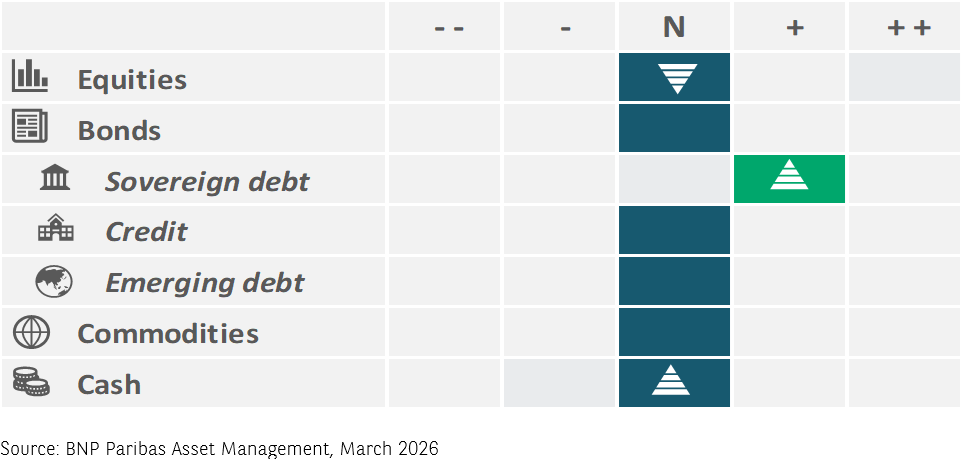
In March, we lowered our global equity allocation to neutral relative to our long-term risk exposure targets. Early assumptions that the Middle East conflict would be short-lived have proven untenable. De-escalation in the coming weeks, if not days, remains our view, but the downside risk is increasing
Ongoing commodity price stress and bond/equity correlation turns positive. The resurgence in oil and gas prices changed interest rate expectations, pushed global equities to November’s lows and credit spreads far wider. Perceived ‘safe havens’ such as gold, have also been hit by inflation concerns, which are driving stagflation fears in developed economies
Buying EU duration; neutral on US Treasuries and US dollar. We have not changed our position on currency markets, and we remain neutral on the dollar. We opened a short duration position in US Treasuries and took profits as global yields subsequently surged. We also opened a position in euro five-year yields as we disagree with expectations that the European Central Bank will raise interest rates three times in 2026
Prudent to cut risk
Global markets moved lower during March as oil and gas prices rose steeply in the wake of the Middle East conflict. The Gulf region’s energy infrastructure came under attack from both sides, bringing a broad sell-off in equity and credit markets. This also saw Europe and Japan unwind recently accumulated outperformance relative to the US.
Having reduced equity risk in the first days of the conflict, we believed it prudent to cut further given the potential downside risk should the conflict, and resulting energy price shock, last several months rather than weeks.
Damage to the gas liquefying infrastructure in the United Arab Emirates is reported to pose a disruptive threat to capacity for several years. We do not know the status of Iran’s infrastructure, but the primary factor influencing oil and gas prices is the question of when the Strait of Hormuz reopens.
Asset class views
Looking ahead
A plethora of strategists’ and analysts’ studies conclude that the vast majority of periods of geopolitical stress see equity markets materially higher within the following 12 months, and sometimes in far shorter time frames.
The conflict’s duration, at the time of writing in its fourth week, is the crucial consideration for risk allocation, with bond yields having risen and provoked a bout of unwelcome equity market correlation.
Few assets have resisted the current shock; stagflation fears have weighed on gold and silver prices. Among our quantitative signals, the information is mixed, although our most reliable models – our machine-learning and the cross-market volatility tools – tilt clearly to a more defensive allocation.
Nonetheless, our specific equity market index models have turned positive for both the US and Eurozone. Sentiment has reached near-extreme levels of fear, and with (option-based) demand for protection reaching higher levels relative to exposure, this indicates conditions consistent with, or close to, a contrarian buying opportunity.
A neutral position today in risk allocation terms could potentially relieve some of the stress of navigating short-term volatility, while leaving open the opportunity to re-engage with risk.
Bond volatility
Bond markets are once again enduring significant volatility. Back in the second quarter of 2025, uncertainty surrounding the outlook for US trade policy (around ‘Liberation Day’) dominated the attention of risk takers and generated significant levels of volatility, both to the downside and to the upside, for equity markets. Risk aversion going into April last year saw bond markets rally as central banks retained an accommodative bias.
That is not the case this year, with uncertainty over central bank policy in the face of a supply-side price shock. In short order, market pricing for the Bank of England’s monetary policy path has given up on rate cuts and added two hikes, while the ECB is now being priced for three hikes this year.
The odds of another cut in the US fed funds rate now fall below 100% certainty, with the market having only recently priced in more than two cuts into year-end despite sticky inflation dynamics. At the Federal Reserve’s March meeting, the median forecast was left unchanged, but there were nonetheless fewer policymakers expecting cuts this year.
Early in March, as US Treasuries rallied to 4% on the back of weaker retail sales and poor job numbers, we took the opportunity to reduce interest-rate sensitivity by selling 10-year US Treasury futures.
We have been concerned for some time that evidence of further progress in inflation towards the Fed’s target was waning. Systematic strategies had been forced into covering short positions1 by the weak numbers, leaving the market better balanced for a sell-off.
The conflict’s outbreak prompted risk-averse investors to add to US duration, buying longer-dated bonds, before fears of the potential inflationary impact of the conflict pushed global yields higher. We have increased our Eurozone duration, in the expectation that the demand shock to consumption from lower real wages will outweigh the supply side shock from higher energy prices – i.e., we believe the ECB will not be required to push through all three rate hikes currently priced in for this year.

[1] Short selling involves borrowing securities to sell, with the aim of buying them back at a lower price later. Covering a short position means repurchasing the borrowed securities, for example, to take profits or to limit losses if the open trade no longer looks like it will be profitable.


