
The prospect of tighter regulations on harmful food additives in the US supports opportunities for natural ingredient companies, write Co-Portfolio Managers Agne Rackauskaite and Katy Hutchinson.1
Rules on potentially harmful food additives are being tightened across the US, reflecting public concern over artificial ingredients in one of the world’s largest food markets.
As consumer preferences and tighter regulation – at both the state and federal level – reshape the US food industry, we believe there are significant opportunities for companies specialising in the reformulation of food products.
Additives are a common concern
Three-fifths of food products bought by Americans contain food additives, including colouring or flavouring agents, preservatives and sweeteners – that is up from half in 2001.
In a 2024 survey, 45% of Americans cited the ubiquity of artificial ingredients in products as one of their top five food-related issues. Common concerns relate to their connection with high childhood obesity and diabetes, which both afflict more than one in five US children, and rising rates of childhood cancer and neurodevelopmental disorders.
Source: Verisk, May 2024.
The tightening ratchet of regulation
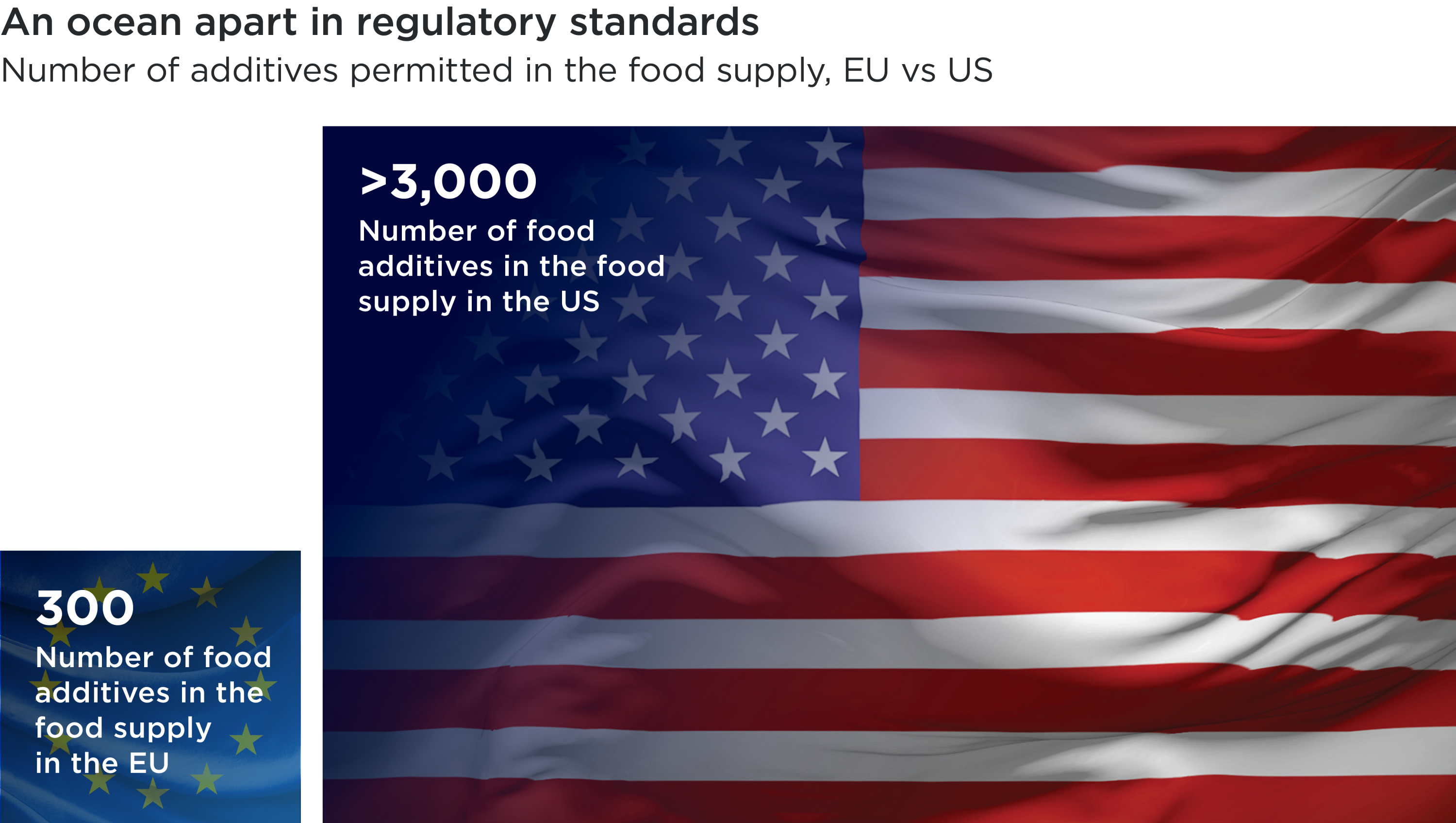
The US has historically lagged other developed markets in regulating the composition of food products and investigating the health impacts of certain ingredients. Additives are much more prevalent in US products. On average, US food and beverage products contain 4.5 additives. In contrast, only one-in-six food products in France contain four additives or more.
Federal and state regulators are now phasing out some of the most harmful additives. The first additive to receive a federal ban, in January 2025, was Red Number 3. Also known as erythrosine, this synthetic food dye – which gives foods and drinks a bright, cherry colour – has been linked to cancer and hyperactivity in children.
As the FDA mulls other nationwide bans on additives, state-level legislation is coming into effect. California and West Virginia, for examples, have respectively announced bans on harmful food dyes, including Blue Numbers 1 and 2 and Yellow Numbers 5 and 6, from school meals.
Ultra-processed food packaging is also in focus. In June, Texas gave food manufacturers until the end of 2026 to place warning labels on products that contain any one of 40-plus synthetic food additives.
Reformulation as a solution
The regulatory direction of travel presents significant challenges for manufacturers, for whom replacing just one ingredient can dramatically impact the taste, colour and texture of products – and so their desirability.
While natural alternatives such as colourants derived from fruits and vegetables can often be used to replace synthetic ingredients, tweaking product formulations can, if unsuccessful, threaten consumer demand for high-value product lines.
To overcome the technical challenge of creating healthier products while maintaining the qualities that consumers demand, many food manufacturers partner with specialist ingredient companies.
As well as developing reformulations that substitute banned or harmful ingredients, there are off-the-shelf solutions that can reduce sugar, fat and salt. Irish-listed Kerry’s ‘Tastesense’ platform provides flavour and taste modulators that maintain flavour intensity and sensory experience while improving their health profile.
DSM-Firmenich, a Dutch-listed peer, offers a range of reformulation solutions. Among its fermentation-based products is a gum that can substitute for carrageenan and gelatin as a gelling agent in applications including confectionery.

Source: Consumer Federation of America, 2024; Ultra-processed Foods: Why They Matter and What to Do About It.
We believe addressing harmful artificial additives in the US should support demand for healthier alternatives, as policies have elsewhere.
We expect the recommendations of the ‘Make America Healthy Again’ (MAHA) Commission to reinforce the US food industry’s appetite for reformulating ultra-processed products. Major US food product manufacturers have already committed to replacing artificial dyes by 2027.
By drawing upon their science-led expertise, we believe specialist ingredients companies can enable the shift towards safer and more nutritious products, without compromising on taste or texture.
[1] This article was previously published by Impax Asset Management @ Moving-beyond-artificial-ingredients-reformulating-the-us-food-industry.


