
The broad recovery in equity indices that started with September’s bigger-than-expected cut in the US fed funds rate has splintered, with US markets continuing to rise, while other markets have faltered.
Disappointing economic data out of Europe and rising geopolitical worries have made investors marginally more cautious.
Particularly acute are worries of an escalation of the conflict in the Middle East. Any consequent spike in crude oil prices could reverse the trend of declining headline inflation and dent consumer confidence. The recent jump in oil prices, though, still leaves it below its end-of-August level (see Exhibit 1). Saudi Arabia’s plans to raise output should keep prices contained in the medium term.

The comparatively disappointing data in Europe was principally in the form of lower purchasing managers’ index (PMI) readings for September versus August, and PMI levels below 50 (indicating contraction) in manufacturing. The picture is not uniform, however, with the indices for Spain and the UK far better than those in Germany, France or Italy (see Exhibit 2).
Exhibit 2
Purchasing managers’ indices mostly lower in September

Data as at 3 October 2024. Note: France services PMI change is versus July. US manufacturing ISM is for August. Sources: FactSet, BNP Paribas Asset Management.
The European Central Bank has already begun cutting policy rates and is expected to continue to do so at its next policy meeting. The question is whether this would be soon enough, and whether it will go far and fast enough to pull the region out of its comparative slump. Germany may well be in a recession this year.
Fortunately, Europe has had better news on inflation: after several months of high readings, core inflation fell back sharply in September.
US jobs market looking better
IIn the US, it was beginning to feel like ‘déjà vu’ all over again: Back in January, markets forecasted a sharp drop in the fed funds rate by the end of 2024, only to see those expectations reverse a few months later when inflation reaccelerated.
Just a month ago markets were again expecting a significant reduction in the key policy rate when rising unemployment seemed to point to a recession. That has now reversed following much better labour market data for September and higher-than-expected CPI inflation (see Exhibit 3).

PMI data also points to a steady expansion of the economy, at least in the services sector. Manufacturing, by contrast, is weak, though it is in many places. The poor US data could be dismissed as simply reflecting global difficulties. Then again, expectations had been high that the subsidies and incentives of the Inflation Reduction Act would lead to much more activity.
Inflation direction still on knife edge
The markets should perhaps have had higher expectations for CPI inflation in September given that the Atlanta Federal Reserve’s GDPNow model was forecasting third-quarter GDP would rise by 3.2% (seasonally adjusted annual rate) – faster than the 3% in the second quarter.
Consensus estimates were for a 0.2% gain month-on-month (2.4% annualised). The actual figure was 0.3% (3.8% annualised; see Exhibit 4).

Worryingly, goods inflation was comparatively strong at 2.1%, when it had been negative on average since January. Even worse was services inflation, running at a 4.4% annual rate, and in contrast to the prior month, this was not solely due to higher shelter prices.
The Fed’s preferred inflation measure is, however, the Personal Consumption Expenditures (PCE) index. The higher CPI rate may not be repeated in the PCE measure, as occurred in August.
Either way, investors will need to consider the risk that inflation will not move down quite as quickly or as easily to the Fed’s 2% target for core inflation as they had hoped. As a result, the funds rate, too, may be higher.
Earnings season preview
Investors will be looking to third-quarter earnings reports for signs of any weakening in consumer activity. There have been anecdotal stories of lower-end consumers struggling to maintain previous levels of demand, though lower energy prices and mortgage rates should provide support.
Earnings growth expectations for the main global indices are varied. The headline figure for the S&P 500 of just 2.8% growth year-on-year masks a wide divergence between earnings for growth/technology stocks and value stocks.
Companies making up the tech heavy NASDAQ 100 are expected to see gains of 11.4% in aggregate, while companies in the Russell Value index may see a decline of 2.2% (see Exhibit 5). Much of the drop in profits for the value index is linked to commodity sectors, however. Excluding energy and materials, earnings growth is positive, but only at 1.6%.

The value orientation of the MSCI Europe index helps explain why expectations for growth are quite modest, at 0.9%. US small-cap stocks and emerging markets ex-China are the standouts. As it is for the NASDAQ 100, the semiconductor industry is driving much of the earnings increase in emerging markets.
We expect that for US companies earnings will come in better than expected (as they typically do), which could drive further gains in markets.
China – Was the recent stimulus enough?
News of a massive stimulus package for the Chinese economy a few weeks ago led to significant outperformance for the equity market. It is notable, though, that the euphoria has not spread far beyond China (see Exhibit 6).

The divergence suggests the drivers for the gains in China were the negative sentiment of institutional investors and underownership of Chinese stocks among hedge funds. Data from Goldman Sachs showed China equity exposure was previously at five-year lows. Valuations were depressed.
The rebound has been so strong that the forward price-earnings ratio for the MSCI index went from 8.7x, nearly 30% below the long-run average, to 10.6x as of 14 October, 12% below the average.
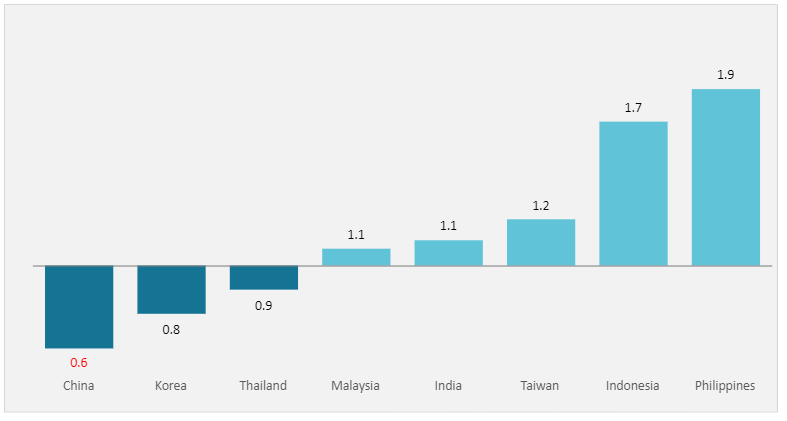
The recovery in valuations suggests that further gains will also need to be driven by positive earnings growth. However, over the last several months, analyst expectations have fallen for companies in the MSCI China index. The ratio of positive to negative estimate revisions for 2025 stands at just 0.6, the lowest of all emerging markets in Asia (see Exhibit 7).
It is likely that this tendency will improve thanks to the stimulus package. The more fundamental question is whether the improvement will be sustained. Chinese equity markets have previously seen significant rallies that eventually reversed once it became clear the measures were not sufficient to improve the underlying trend. This has already happened to some degree.
China faces significant near and long-term challenges: The property market is depressed; without a recovery, consumer sentiment is unlikely to improve, given the significant share of household wealth that property represents. However, Beijing does not appear to want to develop a consumption-driven economy like the US or Europe.
Instead, Beijing is looking to investment and exports. Investment will be in newly emerging industries. It is not clear, however, that these industries can generate the rate of growth for the broad economy Beijing is targeting. Finally, it is unlikely exports can be a sustainable motor of growth given rising protectionism globally.
There is likely more stimulus to come, though China will need to sustain its efforts for longer to turn around both investor sentiment and the economy.
Asset class views
Multi asset
- As the Fed finally begins its monetary easing cycle, the overall decline in inflation coupled with the normalisation of the labour market and the stabilisation of consumer confidence at high levels confirms our scenario of a soft landing for the US economy
- We maintain a slightly positive stance on equities. We favour US technology stocks which, despite high valuations, have high levels of profitability and still-favourable earnings growth prospects
- While our duration exposure is slightly long, our conviction remains high on euro investment-grade credit, which continues to benefit from solid company fundamentals and strong technical support
- Precious metals, and more specifically gold, remains our strongest conviction in a context of declining real rates, a steady appetite from emerging market central banks, and geopolitical uncertainties.
[1] “The Sahm Rule identifies signals related to the start of a recession when the three-month moving average of the national unemployment rate… rises by 0.50 percentage points or more relative to its low during the previous 12 months.” Federal Reserve of St. Louis. This occurred in August.
Disclaimer
This material is issued and has been prepared by BNP PARIBAS ASSET MANAGEMENT UK Limited (“BNPPAM UK”). Registered in England No: 02474627, registered office: 5 Aldermanbury Square, London, England, EC2V 7BP, United Kingdom. BNPPAM UK is regulated by the FCA under UK laws, which differ from Australian laws. In Australia, BNPPAM UK is exempt from the requirement to hold an Australian financial services license under the Corporations Act 2001 in respect of the financial services. This material is distributed in Australia by BNP PARIBAS ASSET MANAGEMENT Australia Limited ABN 78 008 576 449, AFSL 223418. This material is produced for information purposes only and does not constitute:
an offer to buy nor a solicitation to sell, nor shall it form the basis of or be relied upon in connection with any contract or commitment whatsoever or
investment advice.
Opinions included in this material constitute the judgement of BNPP AMAU at the time specified and may be subject to change without notice. BNPP AMAU is not obliged to update or alter the information or opinions contained within this material. Investors should consult their own legal and tax advisors in respect of legal, accounting, domicile and tax advice prior to investing in the financial instrument(s) in order to make an independent determination of the suitability and consequences of an investment therein, if permitted. Please note that different types of investments, if contained within this material, involve varying degrees of risk and there can be no assurance that any specific investment may either be suitable, appropriate or profitable for an investor’s investment portfolio.
Given the economic and market risks, there can be no assurance that the financial instrument(s) will achieve its/their investment objectives. Returns may be affected by, amongst other things, investment strategies or objectives of the financial instrument(s) and material market and economic conditions, including interest rates, market terms and general market conditions. The different strategies applied to the financial instruments may have a significant effect on the results portrayed in this material. Past performance is not a guide to future performance and the value of the investments in financial instrument(s) may go down as well as up. Investors may not get back the amount they originally invested. The performance date, as applicable, reflected in this material, does not take into account the commissions, costs incurred on the issue and redemption and taxes. All information referred to in the present material is available on www.bnpparibas-am.com.


