
A major rotation has been underway in US stock markets with small-cap stocks outperforming their large-cap peers. The ongoing earnings season will likely determine how far this rotation can run. Meanwhile, monetary policy is on hold in both the US and the eurozone.
Listen to the article
ECB – No surprises
The governing council of the European Central Bank (ECB) met on 18 July and made no changes to their monetary policy, keeping the benchmark deposit rate at 3.75%.
The post-meeting communication was broadly in line with market expectations, with the central bank continuing to stress its data-dependent, meeting-by-meeting approach.
Our fixed income team expects the next rate cut in September, followed by another in December and the terminal level for the deposit rate of 2.5% in 2025.
US economy – Making good progress
With inflation making unambiguously good progress toward the US Federal Reserve’s target, both Federal Reserve Governor Waller and New York Federal Reserve President Williams last week relayed the message that if the economic data continues to cooperate, cuts in the fed funds rate will be appropriate in the coming months.
Governor Waller sounded particularly optimistic in his speech entitled Getting Closer, especially given that over the past two years he has held a relatively hawkish position on the rate-setting Federal Open Markets Committee. On the labour market, Waller declared ‘labour supply and demand have finally come into rough balance” and spoke of the “need to keep the labour market in this sweet spot.” In Waller’s view, “there is more upside risk to unemployment than we have seen for a long time”.
Waller similarly communicated a bright view on inflation, calling June’s consumer price inflation (CPI) report the “second month of very good news” and saying that “the evidence is mounting that the first quarter inflation data may have been an aberration and that the effects of tighter monetary policy have corralled high inflation.” He went on to say that he “will be looking for data over the next couple months” to confirm his view that the “current data are consistent with achieving a soft landing.”
At the NY Fed, Williams also highlighted progress, saying “the underlying trend in inflation is now more back on track towards moving to the 2% goal.”
Our fixed income team’s base case view is that the Fed will begin its rate-cutting cycle in September, lowering the funds rate rates 50bp this year and by 100bp in 2025.
Data – Further confirmation of a soft landing?
In the US, data on second-quarter GDP will be published on 25 July, followed by June’s core personal consumption expenditure (PCE) numbers on 26 July.
We may see an acceleration in US GDP growth relative to the first quarter (when it was 1.4% QoQ SAAR), but the composition is likely to be similar. Stronger consumption and larger building of inventories might push the growth rate to above 2%, although weaker federal spending and stronger imports could weigh on the number.
On inflation, investors will be looking closely at the core PCE data to see if it shows a second consecutive month of the rate running at or below the Fed’s 2% target on a monthly annualised basis.
Kamala Harris receives endorsements and funding
Vice President Kamala Harris quickly gained backing from prominent Democrats in the first 24 hours following President Joe Biden’s announced of his exit from the race for the White House.
Initial pledges of support came in late on Sunday 21 July and high-profile endorsements have continued. No prominent Democrats have said they will challenge her.
While the Republican nominee Donald Trump is still generally holding leads in the polls, Kamala Harris’s approval ratings have risen following the 21 July announcement and are now closer to where President Biden’s ratings were before the television debate with Trump on 27 June.
President Biden’s decision to end his campaign and the subsequent emergence of VP Kamala Harris as the frontrunner for the Democratic nomination has not had a major impact on markets.
This is in part because the view of many investors — and the prediction markets — appears to be that former President Trump will still win in November.
An alternative explanation is that it is not yet clear how the policies of a Harris administration might differ, if at all, from the outgoing administration’s policies.
US equities – Earnings season underway
Second-quarter earnings reporting has begun with just under 10% of the S&P500 companies by market cap having reported so far. The next two weeks will see the earnings season heating up with over 60% of the S&P500 by market cap due to report.
In recent weeks there has been a major rotation in the US equity market (see Exhibit 1), with a shift out of the mega-cap stocks that had driven the market rally in favour of smaller companies and other previously neglected sectors.
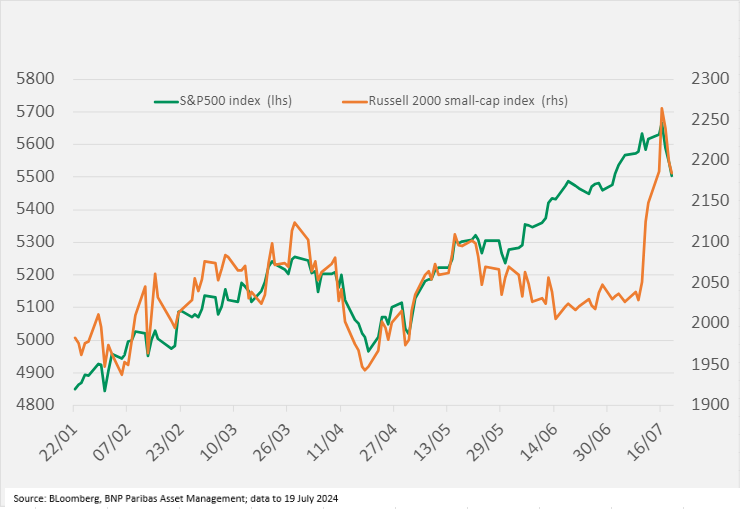
The Russell 2000 small-cap index rallied strongly in a shift sparked partly by weaker US inflation data and an improving earnings outlook.
Valuations of the so-called Magnificent Seven — mega-cap tech stocks that have dominated the broad blue-chip S&P500 index’s gains over the past year – fell last week before stabilising.
Valuation differences between small- and large-cap stocks had reached extreme levels and the strength of the recent small-cap rally is likely due to some investors seeking to cover their underweight positions in a hurry. The latest earnings updates are likely to determine whether the rotation can run further.
Disclaimer
This material is issued and has been prepared by a representative of BNP PARIBAS ASSET MANAGEMENT Australia Limited (“BNPP AMAU”) AFSL 223418 ABN 78 008 576 449.
This material is produced for information purposes only and does not constitute:
1. An offer to buy nor a solicitation to sell, nor shall it form the basis of or be relied upon in connection with any contract or commitment whatsoever or
2. Investment advice.
Opinions included in this material constitute the judgement of BNPP AMAU at the time specified and may be subject to change without notice. BNPP AMAU is not obliged to update or alter the information or opinions contained within this material. Investors should consult their own legal and tax advisors in respect of legal, accounting, domicile and tax advice prior to investing in the financial instrument(s) in order to make an independent determination of the suitability and consequences of an investment therein, if permitted. Please note that different types of investments, if contained within this material, involve varying degrees of risk and there can be no assurance that any specific investment may either be suitable, appropriate or profitable for an investor’s investment portfolio.
Given the economic and market risks, there can be no assurance that the financial instrument(s) will achieve its/their investment objectives. Returns may be affected by, amongst other things, investment strategies or objectives of the financial instrument(s) and material market and economic conditions, including interest rates, market terms and general market conditions. The different strategies applied to the financial instruments may have a significant effect on the results portrayed in this material.
All information referred to in the present document is available on www.bnpparibas-am.com.


