
While a link can be made between recent movements in financial market and trade-related politicking, credit risk suddenly rose to the fore when two US regional banks announced they had suffered losses due to defaults on commercial loans. The news revived memories of the spring 2023 US banking crisis. Those worries faded quickly. Will it be different this time round?
Listen to the article
With global equities up by 18.3% in the year to 20 October, there is no shortage of arguments suggesting a pause or even a correction might be due.
The case, among those who think the rally can’t continue at this pace seems to be mostly based on a naive reading of stock multiples and/or the fact that only a relatively small number of stocks (namely those of the Magnificent 7 companies) are driving valuations higher.
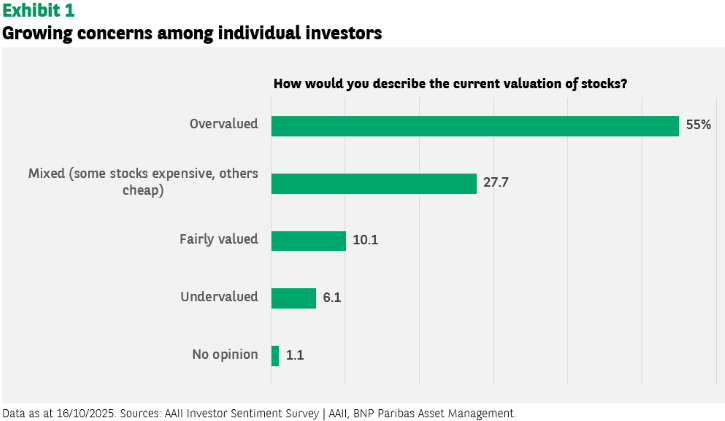
AAII Investor Sentiment Survey | AAII
The narrow base to the stock market rally, perhaps interpreted as fragility, may explain why, at the end of September, only 22% of actively managed funds beat their benchmark – a remarkably low level only seen on three other occasions over the last 25 years.
It may mean that some investors have still not joined the party. Despite the valuations of several stocks skyrocketing, being overweight equities may not be such a crowded trade, meaning equity markets may be more resilient than we think.
Choppy rise in equities so far in October
The changes of the VIX index, which indicates implied volatility on the broad US S&P 500 equity index, probably offer the best illustration of the climate that has prevailed in financial markets in recent days in the face of the latest political and economic news.
The VIX , which had been trading at around 15 since mid-August, suddenly rose to above 20 on 10 October.
The jump came after President Donald Trump’s latest trade comments raised concerns that tensions between the US and China would rise again. China’s Ministry of Commerce had earlier announced new controls on the export of technologies related to the extraction and production of rare earths.
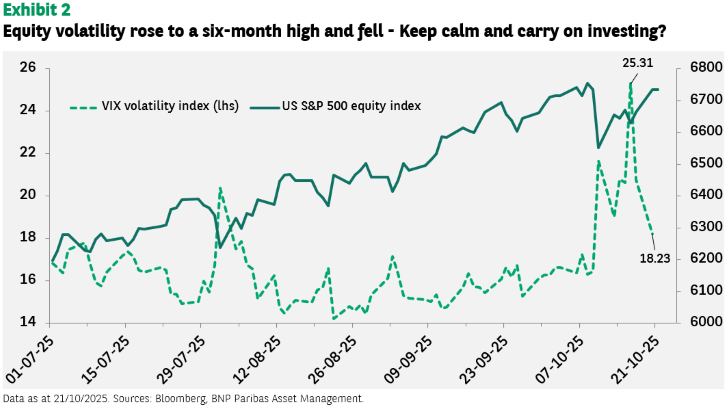
The VIX rose further, to above 25, on 16 October (marking a six-month high) after two US regional banks disclosed issues with bad and fraudulent loans. This revived memories of the spring 2023 US banking crisis, and fuelled concerns over the potential for a domino effect in the credit market related to the recent bankruptcy of a large car-parts manufacturer.
Despite the nervousness, investors appeared keen(er) to grasp any good news coming their way, including the quarterly earnings reports of major US banks, confirmation of a meeting between Presidents Trump and Xi Jinping, and discussions between US Treasury Secretary Scott Bessent and Chinese Vice Premier He Lifeng to prepare for trade negotiations as the 10 November tariff deadline approaches.
Excessive investor optimism?
In its World Economic Outlook published on 14 October, the International Monetary Fund revised up slightly its short-term forecasts from its April outlook.
It warned that “global growth is projected to slow, and growth prospects remain dim, as the world adjusts to a landscape marked by greater protectionism and fragmentation. Global headline inflation is expected to decline further but remain above target in some countries. Risks to the outlook are tilted to the downside. Prolonged uncertainty and escalation of protectionist measures may further hinder growth.”
The risks to the global economy are clear, but the fact remains that with a growth forecast of 3.2% for this year and 3.1% in 2026, the IMF makes no mention of recession.
We note that recent central bank comments and decisions suggest that they do not plan to implement restrictive policies in the coming months.
The US Federal Reserve is thus expected to continue its easing cycle despite the acceleration in inflation that will likely result from higher tariffs. US households and businesses appear in much better financial health than before previous recessions (other than the one arising from the Covid pandemic).
In this environment, microeconomic factors remain favourable, as shown in particular by company earnings reported so far this year.
Confidence justified; legitimate questions
We believe equity markets are not overvalued, particularly in the case of US technology stocks given their high profitability and strong earnings momentum. However, this analysis is based on a scenario of growth not slowing ahead of a recession.
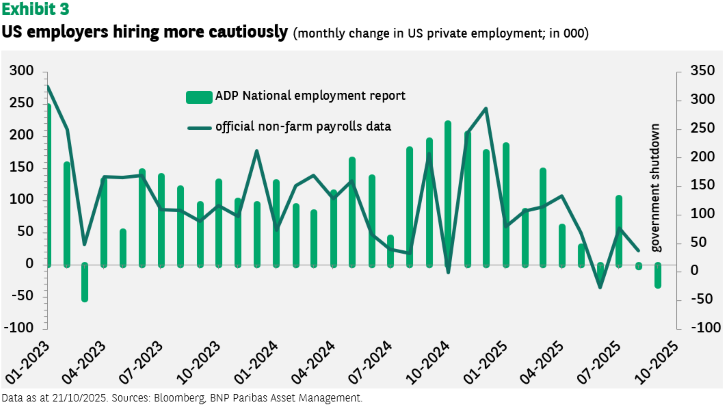
While eurozone growth has so far been more resilient than expected and is forecast to accelerate in 2026, notably due to Germany’s economic stimulus package, the trajectory of the US economy appears linked to developments in the labour market.
The ongoing federal government shutdown is still preventing the release of September’s jobs report and weekly jobless claims data. The ADP survey, published earlier this month, revealed a net downturn in private sector employment in August and September.
The Beige Book, released ahead of the Fed’s next monetary policy meeting, pointed out that “more employers reported lowering headcounts through layoffs and attrition, citing weaker demand, elevated economic uncertainty, and, in some cases, increased investment in artificial intelligence technologies. Those US employers who reported hiring staff generally noted improved labour availability, and some favoured hiring temporary and part-time workers”.
This qualitative (not quantitative) information appears to confirm the diagnosis of a less dynamic labour market where employers are back in the driving seat.
The Fed’s stance – including choosing in September to focus on the ‘maximum sustainable employment’ goal of its dual mandate – appears justified in view of these labour market trends, even though Fed Chair Jerome Powell noted in a speech to the National Association for Business Economics on 14 October that: “Data available prior to the shutdown show that growth in economic activity may be on a somewhat firmer trajectory than expected.”
The Atlanta Fed’s running estimate of third-quarter annualised growth was 3.9% as of 16 October (the first update since 3 October) after accounting for tax receipts published by the US Treasury.
The shutdown in itself does not appear to be threatening growth; rather, it complicates the task of economic forecasters – as well as US monetary policymakers at the Fed when they meet at the end of October.
What news from Paris?
Whatever happens politically over the next few weeks or months in France, we can be sure of one thing: There will be no US-style shutdown. France has legislation in place to ensure the continuation of core state functions until a budget for 2026 is passed in the National Assembly.
This will allow the government to continue collecting taxes and permit state borrowing through the French Treasury Agency. The law authorises four social security organisations to take out loans to maintain their operations. The budget for 2025 was adopted on 6 February.
The budget for 2026 is still in the starting blocks. The Lecornu II government has so far survived two votes of confidence in the National Assembly on 16 October but managed to present the draft finance law (PLF – Projet de loi de finances) for 2026.
However, this was swiftly followed by an announcement from rating agency S&P that it was downgrading France’s sovereign rating from AA- to A+, with a stable outlook. The review of the rating had been scheduled for end November. On 24 October, Moody’s (Aa3; stable) will announce its decision.
For the time being, S&P estimates that “in the absence of significant additional budget deficit-reducing measures, the budgetary consolidation over our forecast horizon will be slower than previously expected.”
Even if the general government deficit target of 5.4% of GDP for 2025 is met, S&P forecasts a budget deficit of 5.3% in 2026 (compared to 4.7% according to government figures) and 5.6% in 2027.
French long-term OAT bond yields showed little reaction to this news, suggesting that deteriorating French public finances and political uncertainty have already been largely taken into account in the levels of yields and bond spreads.
We see this as a metaphor for financial markets as a whole: the information available is sometimes correctly reflected in the price of assets, but the unpredictability of decisions, in Washington or elsewhere, can blur the picture at any time.


