
Strong US earnings season results have helped US equity markets withstand negative news around the Iran war and high oil prices.
Daniel Morris, Chief Market Strategist
Listen to the article
Since Brent crude oil’s recent low of $99 per barrel on 17 April (the pre-war price was $71), prices jumped back up to $124 before dropping to $106 as at 14 May. Over that period, the S&P 500 rose by 5.3% while the MSCI World ex-USA index fell by 0.6% (in local currency terms).
With the earnings season behind us, however, markets may struggle to find good news to offset less positive reports from the Middle East. For the US, economic data may be the source.
US non-farm payrolls showed another month of reasonably strong job creation in April. It has been noted that healthcare once again accounted for the largest share of the gains, but robust job creation in the sector has been the norm for decades as the US population ages. More meaningful were the gains across other parts of the labour market (see Exhibit 1).

Declines in the Financial activities and Information sectors were taken by some as a sign of artificial intelligence-induced job destruction. Given the news headlines about corporate layoffs, there is probably some impact from AI but it seems unlikely that it is significant at this point. Professional services employment still grew, and the losses in Financial activities were concentrated in the (slow moving) insurance sector, while Information declines mostly come from the motion picture industry.
With the adult unemployment rate steady at under 4%, and wage growth improving, the US labour market seems solid for now, which augurs for steady consumer demand in spite of high petrol prices. April’s core retail sales figure, which showed a 0.5% gain on the month, supports this view.
A diverging economic backdrop in Europe and Asia
Europe, by contrast, is at risk if the Strait of Hormuz remains closed and declining oil inventories lead to another spike in prices. Recent economic data has been less encouraging than in the US.
Service sector Purchasing Managers’ Indices declined across most major European countries in April, either moving from expansionary to contractionary territory or falling further into contractionary territory. US services PMIs were steady or improved and showed the sector expanding.
The diverging economic backdrop has been reflected in the performance of European equities this year compared to the US as measured by the Russell Value index, which shares a similar sector makeup.
Until the outbreak of war, returns were similar: both were up 7% by the end of February. Since then, European equities have fallen 3% while US value stocks have gained 4%.
China (and Asia in general) is also more exposed to the crisis than other regions. Credit growth in China has slowed, and PMIs are only slightly in expansionary territory. Exports have been the economy’s saving grace, but this is unlikely to be a sustainable strategy.
Countries on the receiving end of the flood of cheap Chinese imports increasingly worry about their own industrial base and may well increase trade restrictions in the future.
The Iran war, though, has arguably only exacerbated problems in what was an already weak economy. Chinese equities (excluding technology) have underperformed the broader emerging markets universe for the whole of the year to date (see Exhibit 2).
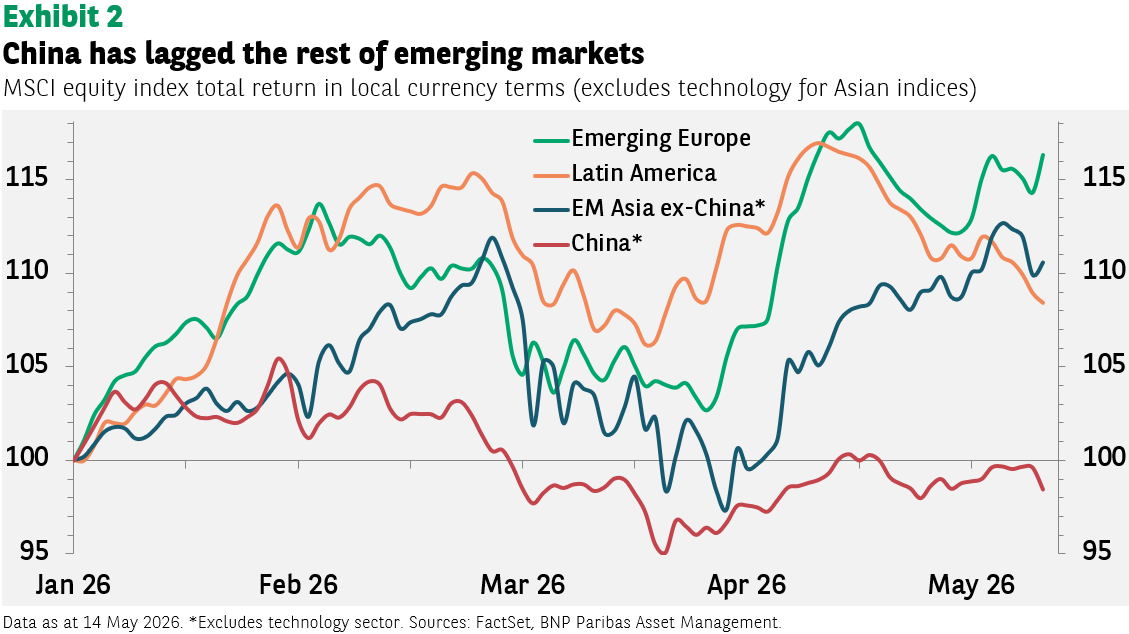
The gap for the technology sector is even larger. While Taiwanese and Korean tech shares are up 58% and 157% year to date, respectively, in China they have dropped by 12%.
Investors in the country’s equities will hope that the recent China-US summit results in some meaningful improvement in the relationship between the two superpowers.


