
Donald Trump has officially been elected as the 47th president of the United States (US). Importantly for the markets, it looks like the Republican Party will gain control of the Senate, while also maintaining its hold on the House of Representatives. This significantly increases the potential for President-elect Trump to implement his policies beyond trade and immigration.
While polls had indicated an evenly matched race, prediction markets put higher odds on a Trump win. The seeming inconsistency can be understood in light of polling data from the 2016 and 2020 elections. In the contest against Hillary Clinton, Trump was behind in the top battleground states by 0.2%, though he went on to win. Against Biden, he was behind by 2%.
Going into this election, he was ahead by 0.8%. That is to say, on a relative basis, he was polling much stronger, hence the greater odds of a victory. There were signs the market was pricing in this outcome, as both US Treasury yields and US equities rose and fell along with his odds of victory.
Now that the results are mostly known, investors will turn to the outlook for the global economy and markets. As a starting point, one can consider the performance of different asset classes during the first Trump presidency (see Exhibit 1).
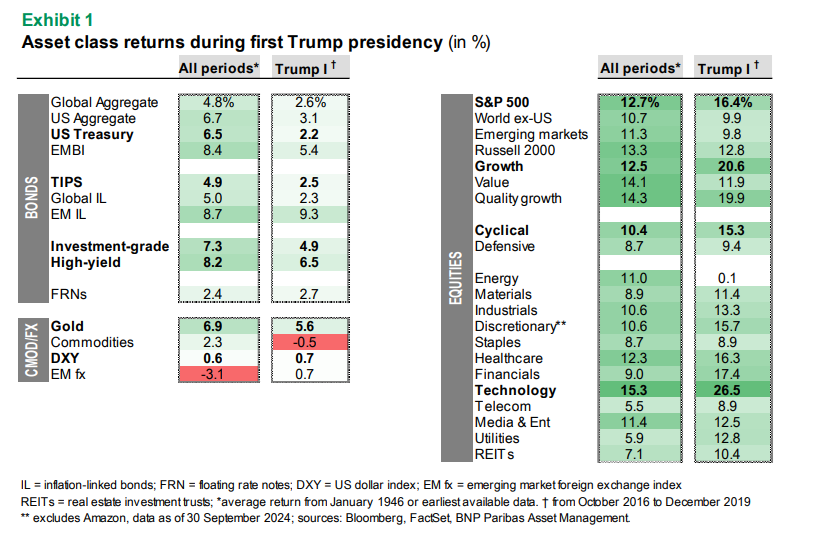
Compared to historical averages, equities outperformed fixed income, and US equities in particular outperformed non-US equities. Despite the boost one would have anticipated to domestic growth from tariffs, the Russell 2000 index did not outperform the S&P 500. This may reflect the fact that average tariffs did not increase much during Trump’s first term.
Growth/technology stocks did well, but one imagines this may have occurred regardless given the broader forces driving the expansion of the sector.
Within fixed income, US TIPS (Treasury Inflation-Protected Securities) did relatively worse compared to US government bonds, though corporate credit performed better. Gold shone, and the US dollar strengthened.
How many of these patterns could repeat in the future? Geopolitics are more fraught today. The US is at a different point in the economic cycle than it was in 2016, when policy rates had been kept low for years following the global financial crisis and inflation was below target. The Fed subsequently began lifting rates due to worries the stimulus from the tax cuts would raise inflation.
While it is clearly impossible to quantify the impact of any policies at such an early stage, it seems reasonable to anticipate relatively higher US growth and inflation compared to expectations before the election. The level of government regulation is likely to decrease. Taxes should fall.
As for risks, investors are worried about the impact of a significant increase in tariffs (and the response from US trading partners) on global growth and inflation. The ‘deglobalisation’ trend that arguably began under the first Trump administration continued under Biden. How much further it advances from here will depend on to what degree the scope of any tariffs imposed by Trump matches comments he has made.
One key difference between today and 2016 is the size of the US budget deficit and outstanding debt. At the end of 2016, the deficit was at 5.5% of GDP versus 7.4% as at June 2024, and US government debt stood at 105% of GDP in 2016 versus 121% at the end of September 2024 (data from FactSet). Given President-elect Trump’s proposals for additional tax cuts, investors are concerned about future levels of US Treasury yields.
Restrictions on immigration would largely return the country to the status quo before President Biden took office, though one would anticipate it could add to wage pressures given the low US unemployment rate (currently at 4.1%). The market’s (and the Fed’s) forecast for the number of cuts in the fed funds rate will likely be revised lower.
The victory of Donald Trump in 2016 caught most investors by surprise, whereas this time the outcome was partially priced in by markets. One hopes that the subsequent evolution of the US stock market mirrors the positive trend investors experienced after his election in 2016.
Disclaimer
This material is issued and has been prepared by BNP PARIBAS ASSET MANAGEMENT UK Limited (“BNPPAM UK”). Registered in England No: 02474627, registered office: 5 Aldermanbury Square, London, England, EC2V 7BP, United Kingdom. BNPPAM UK is regulated by the FCA under UK laws, which differ from Australian laws. In Australia, BNPPAM UK is exempt from the requirement to hold an Australian financial services license under the Corporations Act 2001 in respect of the financial services. This material is distributed in Australia by BNP PARIBAS ASSET MANAGEMENT Australia Limited ABN 78 008 576 449, AFSL 223418. This material is produced for information purposes only and does not constitute:
an offer to buy nor a solicitation to sell, nor shall it form the basis of or be relied upon in connection with any contract or commitment whatsoever or
investment advice.
Opinions included in this material constitute the judgement of BNPP AMAU at the time specified and may be subject to change without notice. BNPP AMAU is not obliged to update or alter the information or opinions contained within this material. Investors should consult their own legal and tax advisors in respect of legal, accounting, domicile and tax advice prior to investing in the financial instrument(s) in order to make an independent determination of the suitability and consequences of an investment therein, if permitted. Please note that different types of investments, if contained within this material, involve varying degrees of risk and there can be no assurance that any specific investment may either be suitable, appropriate or profitable for an investor’s investment portfolio.
Given the economic and market risks, there can be no assurance that the financial instrument(s) will achieve its/their investment objectives. Returns may be affected by, amongst other things, investment strategies or objectives of the financial instrument(s) and material market and economic conditions, including interest rates, market terms and general market conditions. The different strategies applied to the financial instruments may have a significant effect on the results portrayed in this material. Past performance is not a guide to future performance and the value of the investments in financial instrument(s) may go down as well as up. Investors may not get back the amount they originally invested. The performance date, as applicable, reflected in this material, does not take into account the commissions, costs incurred on the issue and redemption and taxes. All information referred to in the present material is available on www.bnpparibas-am.com.


