
Take Two: The world of finance in two minutes
This week
Global stock markets were buoyed by the extended ceasefire in the Middle East and better-than-expected corporate earnings last week, though inflation concerns remained. The S&P 500 and tech-heavy Nasdaq both hit fresh highs, while Japan’s Nikkei 225 broke through 60,000 for the first time. However, the Strait of Hormuz remained closed and oil prices climbed back above $100 a barrel. Overall, in the week to Thursday’s close, the MSCI World NR Index was flat while the S&P 500 and Nasdaq each rose by 1%, and the Eurostoxx 600 fell by 1%.*
*In US dollar terms. Source: FactSet, as of 23 April 2026
Around the world
Eurozone business activity fell to a 17-month low in April, as the service sector suffered its steepest decline since February 2021 and the Middle East conflict caused prices to surge. The flash composite Purchasing Managers’ Index, which covers both services and manufacturing, fell to 48.6 from 50.7 in March (a reading below 50 indicates contraction). Elsewhere, Japan’s composite PMI slowed to 52.4 from 53.0, as the strongest rise in manufacturing since 2014 was offset by a weaker services sector. However, the US composite rose to a three-month high of 52.0 in April.
Figure in focus: 33.8%
Record solar power growth meant clean energy sources expanded fast enough to meet all new electricity demand in 2025, according to Ember’s Global Electricity Review 2026. The think tank highlighted that 2025 was the “first year since 2020 without an increase in electricity generation from fossil fuels and only the fifth year without a rise this century”. In addition, renewables provided 33.8% of the overall global electricity mix, overtaking coal power (at 33.0%) for the first time in 100 years. This was also the first time that renewables contributed more than a third of global electricity generation, Ember said.
Chart of the week
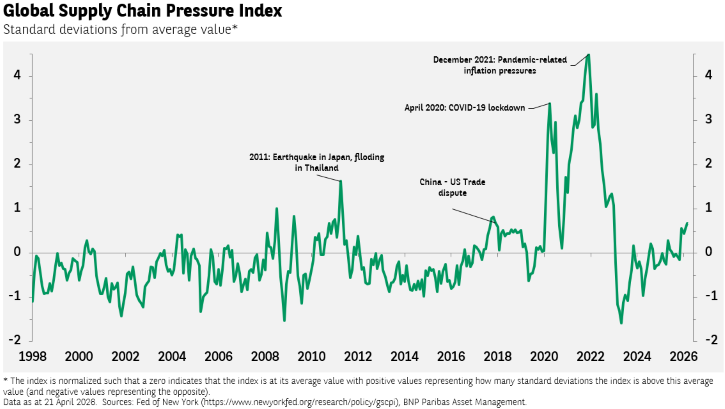
In 2022, the Federal Reserve Bank of New York created an index to gauge global supply chain conditions. It analyses transportation costs data (shipping and air freight) and subcomponents (delivery times, order backlogs, and stockpiling information) taken from business activity surveys such as purchasing managers’ indices (PMIs). Soaring oil prices amid the Middle East conflict, and accumulating inventories due to price and supply concerns, drove the index up to 0.68 in March, its highest since January 2023. However, it remains far from the levels seen in 2021-2022 during the post-pandemic inflation surge. April’s data, released in early May, could indicate whether these mounting pressures on global supply chains pose a threat to global growth.
Words of wisdom: AI tokens
AI tokens are units of data such as words, characters and pixels converted into sequences artificial intelligence models can learn from. Recently, Chinese models have overtaken US rivals in AI token consumption on OpenRouter, the world’s largest platform for large language models, meaning that they are processing more data, according to reports. AI providers charge developers per token and costs are falling rapidly, though Chinese models are significantly cheaper than their US counterparts, helping them to gain ground among users.
What’s coming up?
Monetary policy is in focus this week. The Bank of Japan meets on Tuesday to set interest rates, while Wednesday sees the Bank of Canada and the Federal Reserve convene for their respective monetary policy meetings. The European Central Bank and the Bank of England hold their own rate-setting meetings on Thursday. In terms of economic updates, Thursday also sees preliminary estimates for Eurozone Q1 GDP growth and April inflation data, while the US issues an advance estimate of Q1 economic growth.


