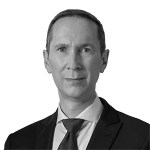
Reviewing the outcome of the recent UN Climate Summit, Climate Change Lead Thibaud Clisson tells Andrew Craig, Co-head of the Investment Insights Centre, that amid the mixed results, there was progress on greater transparency in carbon markets and measures to tackle climate change fallout in developing countries.
They also discuss hopes that next year’s COP conference can make progress on commitments to transitioning away from fossil fuels. Thibaud sees scope for China and Brazil to take on stronger roles in climate negotiations should the new US administration withdraw from the Paris Agreement.
You can also listen and subscribe to Talking Heads on YouTube, Spotify, or wherever you normally get your podcasts.
'%20stroke-linecap='round'%20stroke-linejoin='round'%20stroke-width='1.5'%3E%3Cg%20id='Groupe_2053'%20transform='translate(0.000000,%200.000000)'%3E%3Cg%20id='Groupe_2052'%20transform='translate(0.000000,%200.000000)'%20stroke='%23000000'%3E%3Cpath%20d='M18.4540324,59.8528676%20L53.9497699,59.8528676%20M18.4540324,46.9257252%20L53.9497699,46.9257252%20M18.4540324,33.7194065%20L53.9497699,33.7194065%20M49.3206324,1.68214405%20L49.3206324,15.8351117%20C49.3268545,18.7239746%2051.6700073,21.0660674%2054.5664199,21.0785262%20L70.1474885,21.0785262%20M71,88.1573858%20L71,97.21999%20C70.9921897,99.8577889%2068.8493379,101.993774%2066.2046228,102%20L4.79395637,102%20C2.1494732,101.99377%200.00703000231,99.8575597%206.82121026e-13,97.21999%20L6.82121026e-13,4.78284428%20C0.00702293205,2.14481193%202.14901353,0.007786332%204.79395637,3.41060513e-13%20L46.7673604,3.41060513e-13%20C49.8036296,0.164165919%2052.6966954,1.34042575%2054.9827296,3.34019673%20L67.5729037,15.6253751%20C69.6239707,17.8560674%2070.8352532,20.7275985%2071,23.7498333%20L71,57.5783595'%20id='Tracé_4850'%3E%3C/path%3E%3C/g%3E%3Cline%20x1='18.4540324'%20y1='72.9897466'%20x2='53.9497699'%20y2='72.9897466'%20id='Ligne_2193'%20stroke='%231D1E1C'%3E%3C/line%3E%3C/g%3E%3Cline%20x1='70.5'%20y1='65'%20x2='70.5'%20y2='83'%20id='Ligne_2194'%20stroke='%23018D54'%3E%3C/line%3E%3C/g%3E%3C/g%3E%3C/svg%3E)
Read the transcript
This is an edited transcript of the Talking Heads podcast episode What are the takeaways from the COP29 climate talks?
Andrew Craig: Hello and welcome to the BNP Paribas Asset Management Talking Heads podcast. Every week, Talking Heads will bring you in-depth insights and analysis through the lens of sustainability on the topics that really matter to investors. In this episode, we’ll be discussing the outcome of the recent United Nations Climate Summit, better known as COP29, which was held in Azerbaijan. I’m Andy Craig, Co-head of the Investment Insight Centre, and I’m joined by Thibaud Clisson, who is Climate Change Lead in our Sustainability Centre. Welcome, Thibaud.
Thibaud Clisson: Good afternoon, Andy. Good to be here.
AC: COP29 is now over, but so far, the reactions to the outcome have been quite mixed. What are your takeaways from COP29?
TC: COP29 was not that successful and has left many stakeholders unsatisfied. It’s fair to say that there were some improvements and announcements, so it’s not a complete failure. Several stakeholders have said that a bad deal is maybe better than no deal at all. This is exactly where we are right now. There was some clear improvement on article 6 that we have been waiting for since 2015, which now provides more visibility on carbon markets.
The key question going forward will be, will those improvements be enough to restore confidence and integrity on voluntary carbon markets? Without going too much into the details, there are two components on article 6.1 [of the Paris Agreement], which is linked to the exchange of carbon credits between countries and another one between companies and countries, the so-called article 6.4. On this part, I’m still cautious. I believe it still opens the door to misleading practices for private sectors, but all in all, article 6 was needed and will allow more money to go where it is clearly needed: to developing countries and to climate mitigation and adaptation projects, and nature conservation. So that was one of the main outcomes.
The other one was the main goal of this COP. What we call the new collective quantified goal – the N C Q G – which replaced the former commitment from developed countries to allocate USD 100 billion to developing countries. The outcome is below expectations because we’re talking about USD 300 billion per annum, while some stakeholders were expecting something like USD 1.3 trillion. The deal is not really satisfactory for anyone. Basically, developed countries wanted to expand the contributing countries to China and Saudi Arabia, and also to allow for private contributions to be accounted for. On the other side, developing countries wanted more money. The deal is a good basis for next year’s COP discussions. It’s a floor. It leaves the door open for voluntary contribution by other countries. Another important component is seeking to bring the USD 300 million commitment to USD 1.3 billion.
There will be a lot of discussions in the next few months on how to increase this amount of money, how to channel more money to developing countries, and the interest rates that developing countries need to pay for green projects. A representative of the Brazilian government highlighted that developing renewable projects in Brazil is twice as expensive in terms of interest rates. This will need to be addressed.
There were other announcements which are good to have in mind: a commitment on methane; 30 countries promised to set up targets to focus on reducing methane emissions from organic waste. The other one is on food – the Baku Harmonia Climate Initiative which is targeting farmers. The idea is to combine and streamline the flows of information around climate actions for farmers.
I think the two first improvement, Article 6 and the new collective quantified goals, even if below expectations, are still something that we can work on and, as mentioned, a bad deal is better than no deal at all.
AC: Yes, because there were fears at one stage would be no deal at all. So, there’s been some progress, and the focus now will be on next year’s COP30 in Brazil. What do you think will be the key topics next year?
TC: First, [in] February 2025, countries need to announce their 2035 emission reduction targets. We hope all of the parties will announce the reduction targets by then, and then there will be a lot of discussions around how those indices are sufficiently ambitious or not.
Another big topic will be the ‘loss and damage’ discussions. Last year, during COP, the launch of the loss and damage fund was announced, but no progress has been made especially during this COP, so the question on how to raise money to help nations to deal with the [loss] and damage caused by climate-related disasters is still completely unanswered and this will be one of the key discussions going forward.
The other big topic is adaptations. There were a lot of discussions during this COP on adaptations. They announced the launch of the Baku adaptation roadmap, but to be honest, very little progress was achieved and clearly more work needs to be done in the coming months on developing indicators to track how the global goal on adaptation will be implemented and on the development of national adaptation plans.
The last point is what we call the global stocktake. Last year, there were a pledge on transitioning away from fossil fuels. Even if the wording was quite blurred, it was a key achievement of the last COP. This year, no mention was made to this pledge. So [at the] next COP, we need to address how we track the implementation of that pledge.
So, for me, that’s the four main topics that will be key to track for the next COP in Brazil.
AC: It sounds like it’s quite a lot to keep an eye on. If we come back to COP29, how do you think the outcome of COP29 is going to impact asset managers or the companies that they invest in?
TC: The two main outcomes of the COP – the Baku to Belém roadmap and the Article 6 improvements – could impact the private sectors.
If we look at the Baku to Belém roadmap, this is the initiative that is seeking to bring the USD 300 million committed this year to USD 1.3 billion, which is what is really needed to finance climate change, mitigation and adaptation. We need to find almost USD 1 billion per year of additional commitment and money. I don’t think this money will come from the public sector. The private sector will be needed. Companies will be subject to pressure to increase their contribution to finance the energy transition in developing countries.
Regarding article 6.4, which is more specific to the exchange of carbon credit between countries and corporates, I think [this] will be quite interesting to look at because the voluntary carbon market have not been that appealing over the last couple of years, especially the last two years. So, maybe what has been announced could provide more clarity and more appetite for a voluntary carbon market.
AC: The other event which potentially is going to have an influence on the negotiations, is the election of Donald Trump in the US. There is already discussion about the potential withdrawal of the US from the Paris Agreement which set the goal of cutting global greenhouse gas emissions to limit global temperature increases to as close as possible to 1. 5 degrees Celsius. So, as I say, there’s a lot of discussion about the possibility of the US withdrawing from that agreement. What would that mean, Thibaud, for future climate negotiations?
TC: As the US is still the biggest greenhouse gas emitter in absolute terms, and historically speaking, the major contributor to global warming, if the US effectively leaves the Paris Agreement, it’s clearly not a good sign. It could act as a signal for other countries [to] withdraw from the Paris Agreement. This did not happen last time the US withdrew from the Paris Agreement, but you never know.
But maybe this could be the starting point of a broader reshaping of the power dynamics in climate negotiations. The key question will be, is China willing to play a stronger role? Over the last [few] years, China has substantially increased its leadership on most of the green and low-tech technologies, and they control most of the supply chain of raw materials which are key for the energy transition. You could ask yourself the question if they will be tempted to expand their technological leadership towards more political leadership.
The other question is Brazil. Brazil will be the host of the next COP. They are one of the key members of the so-called BRICS. They could be tempted to play a bigger role in climate negotiation and be the voice of the developing countries.
So, the election of Trump and the withdrawal of the US from the Paris Agreement could be translated into a complete reshaping of climate negotiations and having the developing countries playing a much bigger role and a much [more] proactive role than they have done in the past.
AC: Well, Thibaud, that’s very helpful in updating us on where we are on this long and winding road towards the energy transition. Thank you very much for joining me today. TC: Thanks for having me, Andy, and it was a pleasure.
Disclaimer
Please note that articles may contain technical language. For this reason, they may not be suitable for readers without professional investment experience. Any views expressed here are those of the author as of the date of publication, are based on available information, and are subject to change without notice. Individual portfolio management teams may hold different views and may take different investment decisions for different clients. This document does not constitute investment advice. The value of investments and the income they generate may go down as well as up and it is possible that investors will not recover their initial outlay. Past performance is no guarantee for future returns. Investing in emerging markets, or specialised or restricted sectors is likely to be subject to a higher-than-average volatility due to a high degree of concentration, greater uncertainty because less information is available, there is less liquidity or due to greater sensitivity to changes in market conditions (social, political and economic conditions). Some emerging markets offer less security than the majority of international developed markets. For this reason, services for portfolio transactions, liquidation and conservation on behalf of funds invested in emerging markets may carry greater risk.