
Delivering legislation, regulation and standards that foster sustainable and a more equitable development is central to tackling sustainability issues. One impediment is corporate lobbying designed to mitigate or even thwart effective policy changes. We urge other investors to join us in ramping up engagement with companies on this important topic.
The effects of corporate lobbying have become clear in recent years in relation to climate change. Extensive research by InfluenceMap, an independent not-for-profit think tank, has revealed how. Its findings have been embedded in the Net Zero Corporate Benchmark published by Climate Action 100+ (CA100+) which is widely used by investors to assess and engage with companies on this topic.
In recent years, we have engaged with many major emitters to ask them to align both their direct lobbying and that of the industry associations they belong to (known as indirect lobbying) with the goals of Paris agreement in accordance with the Global Standard on Corporate Climate Lobbying. We launched this standard in 2022 with AP7 and the Church of England Pensions Board. We have enjoyed substantial success (see pages 46-47 of our Global Sustainability Report 2021).
We are now also addressing another topic where ambitious policy change is clearly needed – diets and health.
Advocating for change – food systems
Together, poor diets now generate more disease worldwide than physical inactivity, alcohol and smoking combined.[1] About 2.6 billion people – 38% of the world population – are overweight or obese. Of those, more than 1 billion people worldwide are obese – 650 million adults, 340 million adolescents and 39 million children, as shown in Exhibit 1.
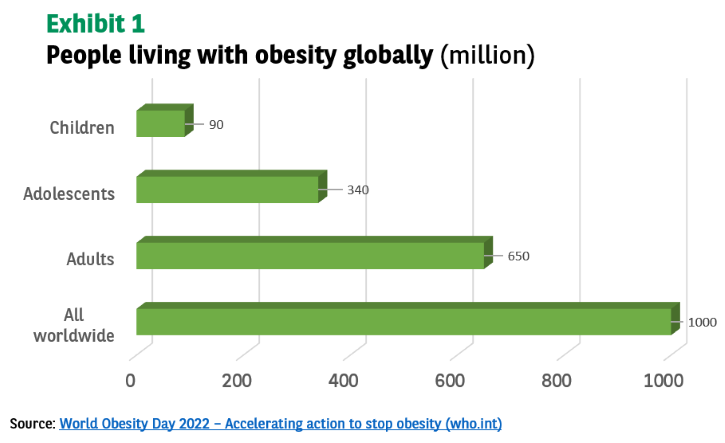
If recent trends continue, without widespread adoption of taxes and limits on the promotion of unhealthy food, those figures are expected to rise to more than 4 billion people (51%) in 12 years’ time, according to research by the World Obesity Federation.[2]
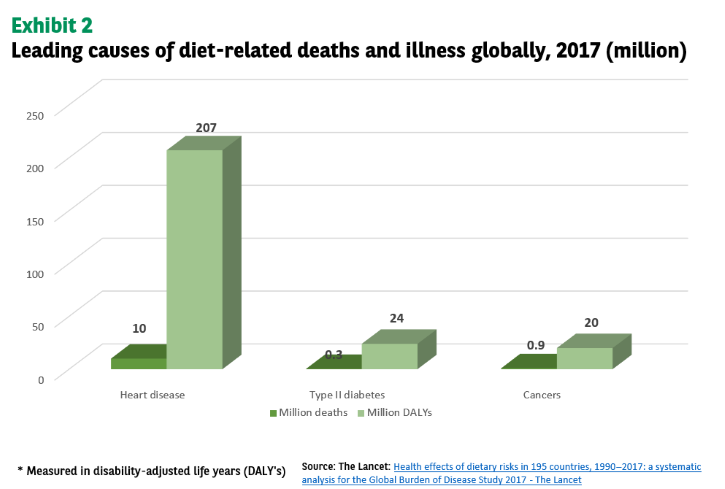
The more overweight someone is, the more likely they are to suffer from a range of diet-related diseases, including heart disease and stroke, Type II diabetes, musculoskeletal disorders and 13 cancers (see Exhibit 2). High levels of diet-related disease impair a country’s economic growth, take up substantial proportions of their healthcare budgets, reduce workers’ productivity across all sectors and impose serious burdens on individuals and families, particularly those on low incomes.[3], [4]
Just as with climate change, the solution to the global diet-driven health crisis lies not in individual action, but in systems change. Narratives about individuals needing to take more personal responsibility and discipline themselves to eat better are gradually being displaced by those that recognise this.
One of the main reasons for a poor diet is the lack of access to and affordability of healthy and unprocessed foods, with highly processed convenience foods, high in fat, sugar and salt, being more easily available and cheaper, often underpinned by subsidies and other distorting policies.
The World Health Organization and public health advocates have long championed policy measures such as stricter front-of-pack (FOP) labelling requirements, restrictions on marketing unhealthy foods to children and fiscal measures such as sugar taxes. Policymakers are increasingly heeding their calls. The World Cancer Research Fund International (WCRF) tracks all such advances in its NOURISH database, and earlier this year recorded the 1,000th such policy action in Europe alone.[5]
Holding back change
However, evidence is mounting that food and beverage companies are directly and through trade associations obstructing, preventing and weakening policy proposals. This is despite more and more of them committing to supporting public health and nutrition and urging sector-wide progress.
As a signatory to the Access to Nutrition Initiative (ATNI) Investor Expectations on Nutrition, Diets and Health, we were pleased that in December 2022, ATNI published a benchmark of the world’s 25 largest food & beverage companies’ lobbying-related commitments, management systems, and disclosure.
ATNI evaluated companies’ practices against the Responsible Lobbying Framework (RLF). This provides investors with a starting point for engagement in support of the third pillar of the Investor Expectations: “Companies should…adopt the five principles and associated management practices set out in the [RLF]: legitimacy, transparency, consistency, accountability and opportunity.”
The results of the evaluation were concerning: The average score was 21% across all companies, with individual scores ranging from 3% to 50%. While there was a wide variation in company maturity, current practice is clearly far from the standard set in the RLF.
Engaging for change
We have begun engaging with some of the rated companies held in our portfolios using ATNI’s results. We want to encourage them to:
- Set high-level commitments to lobby in support of public health policy measures
- Translate them into action through effective management systems
- Be open and transparent about their activities through comprehensive disclosure.[6]
We urge other investors to join us to amplify our voice and convince food companies to lobby in support of policy measures to improve diets and public health, and to disclose fully their advocacy activities.
[1] GBD 2017 Diet Collaborators, ‘Health effects of dietary risks in 195 countries, 1990–2017: a systematic analysis for the Global Burden of Disease Study 2017’ (2019) The Lancet 393(10184): 1958–72 https://www.thelancet.com/article/ S0140-6736(19)30041/fulltext
[2] World_Obesity_Atlas_2023_Press_Release.pdf (worldobesityday.org)
[3] OECD, The Heavy Burden of Obesity: The Economics of Prevention (2019, OECD Publishing, Paris) https://doi. org/10.1787/67450d67-en.
[4] The World Bank, ‘The World Bank and nutrition’ (2019) https://www.worldbank.org/en/topic/nutrition/overview
[5] Nutrition in Europe: there’s work to do | WCRF International [6] It is important to note that the ATNI research was not designed to identify examples of corporate lobbying on nutrition and health policy measures.
Disclaimer
This material is issued and has been prepared by BNP PARIBAS ASSET MANAGEMENT UK Limited (“BNPPAM UK”). Registered in England No: 02474627, registered office: 5 Aldermanbury Square, London, England, EC2V 7BP, United Kingdom. BNPPAM UK is regulated by the FCA under UK laws, which differ from Australian laws. In Australia, BNPPAM UK is exempt from the requirement to hold an Australian financial services license under the Corporations Act 2001 in respect of the financial services. This material is distributed in Australia by BNP PARIBAS ASSET MANAGEMENT Australia Limited ABN 78 008 576 449, AFSL 223418. This material is produced for information purposes only and does not constitute:
an offer to buy nor a solicitation to sell, nor shall it form the basis of or be relied upon in connection with any contract or commitment whatsoever or
investment advice.
Opinions included in this material constitute the judgement of BNPP AMAU at the time specified and may be subject to change without notice. BNPP AMAU is not obliged to update or alter the information or opinions contained within this material. Investors should consult their own legal and tax advisors in respect of legal, accounting, domicile and tax advice prior to investing in the financial instrument(s) in order to make an independent determination of the suitability and consequences of an investment therein, if permitted. Please note that different types of investments, if contained within this material, involve varying degrees of risk and there can be no assurance that any specific investment may either be suitable, appropriate or profitable for an investor’s investment portfolio.
Given the economic and market risks, there can be no assurance that the financial instrument(s) will achieve its/their investment objectives. Returns may be affected by, amongst other things, investment strategies or objectives of the financial instrument(s) and material market and economic conditions, including interest rates, market terms and general market conditions. The different strategies applied to the financial instruments may have a significant effect on the results portrayed in this material. Past performance is not a guide to future performance and the value of the investments in financial instrument(s) may go down as well as up. Investors may not get back the amount they originally invested. The performance date, as applicable, reflected in this material, does not take into account the commissions, costs incurred on the issue and redemption and taxes. All information referred to in the present material is available on www.bnpparibas-am.com.