
Making the food sector more efficient
At every stage of its journey from farm or fishery to family dinner, a large slice of the food produced for human consumption is thrown away. The quantity and impact of food loss and waste has increased as populations grow, climate change drives supply chain disruptions and more resource-intensive foods are consumed.
The production of food and drinks is ultimately responsible for about one-third of global greenhouse gas (GHG) emissions.1 In turn, it is estimated that food loss and waste accounts for 8% to 10% of GHG emissions worldwide.2
Wasteful practices are ripe for disruption, especially since they carry such a high environmental – and financial – cost. In the US alone, the value of wasted food in 2019 totalled USD 285 billion.3
We believe companies that can successfully mitigate food loss or waste with their products and services can offer compelling investment opportunities and play a material role in the transition to a more sustainable economy.
Food waste – especially in the home
The UN estimates that as much as 39% of the world’s food is lost or wasted and goes unconsumed.4
Wasteful practices can occur at all stages of the food supply chain – in production, processing, retailing and in storage and transport – as well as in the hands of consumers. Household and retail food waste varies widely between countries, driven by factors including consumer behaviour, the structure of grocery markets and waste collection practices.
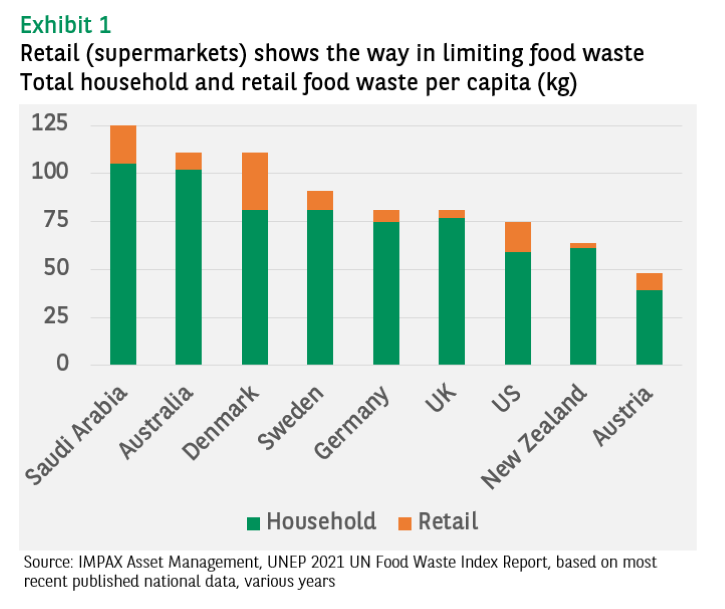
Authoritative data is relatively limited, but figures published by the UN show the scale of food waste in homes worldwide alongside some successes by the retail sector in eliminating waste.5
Exhibit 1 below compares annual food waste at the retail and consumer stages, per capita, for nine economies where the UN has a high degree of confidence in both datasets. Taking the example of the UK, households wasted fully 77kg per person in 2020 – that is the average weight of a British adult. The UK retail sector jettisoned only 4kg of food per person. This shows that good practices can significantly mitigate waste.
Policy tailwinds behind food loss mitigation
Recognising the financial and environmental costs that high levels of waste incur for society, many governments have targets to address the issue. The US, Japan and Australia are among those explicitly aiming to halve food loss by 2030. This aligns with a global target specified by the UN to realise Sustainable Development Goal 12 – to ensure sustainable consumption and production patterns.6
Various governments have launched initiatives, and in some cases enacted legislation, to combat food waste. UK companies can now be fined up to GBP 10 000 for repeatedly failing to address food waste, for instance.7
There have already been successes: in Denmark, the Stop Food Waste Campaign reduced household food waste by 24% per capita between 2013 and 2017 by reducing portion sizes and discounts that encouraged overbuying, and by encouraging diners to take home restaurant leftovers.8
Pockets of innovation
We believe food waste can be addressed in each part of the value chain. Companies are already mitigating waste, directly and indirectly, through their products and solutions.
Direct mitigation involves limiting losses at any stage of the food production journey. For a seed manufacturer, mitigation could involve enhancing yields by improving disease resistance and adaptability. Seed companies can also reduce post-harvest losses by improving food products’ shelf lives and resistance to cracking. Using state-of-the-art technology and analytics, companies can help their agricultural customers target crop safety and resolve growth issues.
Efficiencies can be found in food preparation too. Makers of commercial kitchen equipment and technology can directly reduce waste by improving the efficiency of professional kitchen operations which, by their large commercial nature, should be much less wasteful with ingredients and portion sizing than households.
Companies that provide food products to consumers typically mitigate food loss indirectly by working to keep it out of landfills and incinerators. Restaurants, supermarkets and food delivery companies inevitably use less than 100% of the food they order or prepare. Some make effective use of the leftovers and peels by donating edible food to local charities and composting the rest or converting it to animal feed.
Some of the leading home delivery companies have designed out waste by shortening supply chains relative to traditional grocers. These companies deliver portion-based meal kits directly to customers’ doorsteps, thereby reducing overbuying by consumers, controlling portion size and avoiding food wasting away on shop shelves. Researchers concluded that customers in Germany cut their food waste by 21% (by weight) versus traditional supermarket shopping, with 72% fewer food scraps.9
Accelerating the transition
Resource efficiency is a central pillar of the transition to a more sustainable global economy. Given the food sector’s vast environmental footprint, addressing wasteful practices can make a major contribution to meeting emission reduction targets and reducing the ecological impacts of agriculture.
Meanwhile, we believe companies that tackle food waste and are transparent in their disclosures will
better navigate evolving norms and laws that demand higher standards across developed markets.
Combined with the enormous financial incentives to reduce costly waste, we see long-term investment opportunities where companies offer effective solutions to the challenge. Leaders whose products or services mitigate food waste and advance efficiencies should be well positioned to benefit from, and contribute to, the acceleration of the sustainable transition.
References
1 P.R. Shukla, J. Skeg et al, 2019. Climate change and land: An IPCC special report
2 United Nations Environment Programme, 2021: UNEP Food Waste Index Report 2021
3 ReFED, What is Food Waste
4 Champions 12.3. SDG Target 12.3 on Food Loss and Waste: 2021 Progress Report
5 UNSDG, UNEP & WRAP (Waste and Resources Action Programme), 2021: UN Food Waste Index Report
6 United States 2030 Food Loss and Waste Reduction Goal | US EPA
7 UK Government. Action to reduce food waste announced. 2018
8 Stop Wasting Food Movement, EU Fusion
9 HelloFresh_Sustainability_Report_2021_Non_Financial_Report.pdf (hellofreshgroup.com)
Disclaimer
This material is issued and has been prepared by BNP PARIBAS ASSET MANAGEMENT UK Limited (“BNPPAM UK”). Registered in England No: 02474627, registered office: 5 Aldermanbury Square, London, England, EC2V 7BP, United Kingdom. BNPPAM UK is regulated by the FCA under UK laws, which differ from Australian laws. In Australia, BNPPAM UK is exempt from the requirement to hold an Australian financial services license under the Corporations Act 2001 in respect of the financial services. This material is distributed in Australia by BNP PARIBAS ASSET MANAGEMENT Australia Limited ABN 78 008 576 449, AFSL 223418. This material is produced for information purposes only and does not constitute:
an offer to buy nor a solicitation to sell, nor shall it form the basis of or be relied upon in connection with any contract or commitment whatsoever or
investment advice.
Opinions included in this material constitute the judgement of BNPP AMAU at the time specified and may be subject to change without notice. BNPP AMAU is not obliged to update or alter the information or opinions contained within this material. Investors should consult their own legal and tax advisors in respect of legal, accounting, domicile and tax advice prior to investing in the financial instrument(s) in order to make an independent determination of the suitability and consequences of an investment therein, if permitted. Please note that different types of investments, if contained within this material, involve varying degrees of risk and there can be no assurance that any specific investment may either be suitable, appropriate or profitable for an investor’s investment portfolio.
Given the economic and market risks, there can be no assurance that the financial instrument(s) will achieve its/their investment objectives. Returns may be affected by, amongst other things, investment strategies or objectives of the financial instrument(s) and material market and economic conditions, including interest rates, market terms and general market conditions. The different strategies applied to the financial instruments may have a significant effect on the results portrayed in this material. Past performance is not a guide to future performance and the value of the investments in financial instrument(s) may go down as well as up. Investors may not get back the amount they originally invested. The performance date, as applicable, reflected in this material, does not take into account the commissions, costs incurred on the issue and redemption and taxes. All information referred to in the present material is available on www.bnpparibas-am.com.