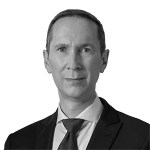
Abstimmungen und Engagement sind für jeden langfristig orientierten Anleger von Bedeutung. Verantwortungsbewusste Vermögensinhaber stimmen auf Hauptversammlungen ab und treten in den Dialog mit Emittenten von Schuldtiteln und Aktien (Unternehmen, Regierungen oder andere). Was waren bisher ihre Schwerpunkte in diesem Jahr und was steht noch bevor? Michael Herskovich, Global Head of Stewardship, erklärt in der dieswöchigen Ausgabe, worauf es ankommt.
Obwohl über weniger über umwelt- und sozialpolitische Vorschläge abgestimmt wurde, genießen diese weiterhin breite Unterstützung. Beim Engagement hebt Michael die Energiewende, Gleichheit und gesunde Ökosysteme als Kernthemen für BNP Paribas Asset Management hervor und merkt an, dass Künstliche Intelligenz inzwischen ebenfalls auf der Agenda steht.
Sie können Talking Heads auch auf YouTube, Spotify oder wo auch immer Sie Ihre Podcasts normalerweise erhalten, anhören und abonnieren.
'%20stroke-linecap='round'%20stroke-linejoin='round'%20stroke-width='1.5'%3E%3Cg%20id='Groupe_2053'%20transform='translate(0.000000,%200.000000)'%3E%3Cg%20id='Groupe_2052'%20transform='translate(0.000000,%200.000000)'%20stroke='%23000000'%3E%3Cpath%20d='M18.4540324,59.8528676%20L53.9497699,59.8528676%20M18.4540324,46.9257252%20L53.9497699,46.9257252%20M18.4540324,33.7194065%20L53.9497699,33.7194065%20M49.3206324,1.68214405%20L49.3206324,15.8351117%20C49.3268545,18.7239746%2051.6700073,21.0660674%2054.5664199,21.0785262%20L70.1474885,21.0785262%20M71,88.1573858%20L71,97.21999%20C70.9921897,99.8577889%2068.8493379,101.993774%2066.2046228,102%20L4.79395637,102%20C2.1494732,101.99377%200.00703000231,99.8575597%206.82121026e-13,97.21999%20L6.82121026e-13,4.78284428%20C0.00702293205,2.14481193%202.14901353,0.007786332%204.79395637,3.41060513e-13%20L46.7673604,3.41060513e-13%20C49.8036296,0.164165919%2052.6966954,1.34042575%2054.9827296,3.34019673%20L67.5729037,15.6253751%20C69.6239707,17.8560674%2070.8352532,20.7275985%2071,23.7498333%20L71,57.5783595'%20id='Tracé_4850'%3E%3C/path%3E%3C/g%3E%3Cline%20x1='18.4540324'%20y1='72.9897466'%20x2='53.9497699'%20y2='72.9897466'%20id='Ligne_2193'%20stroke='%231D1E1C'%3E%3C/line%3E%3C/g%3E%3Cline%20x1='70.5'%20y1='65'%20x2='70.5'%20y2='83'%20id='Ligne_2194'%20stroke='%23018D54'%3E%3C/line%3E%3C/g%3E%3C/g%3E%3C/svg%3E)
Lesen Sie das Transkript
Talking Heads – Stewardship with Michael Herskovich
Daniel Morris: Hello and welcome to the BNP Paribas Asset management Talking Heads podcast. Every week, Talking Heads will bring you in-depth insights and analysis through the lens of sustainability on the topics that really matter to investors. In this episode, we’ll be discussing stewardship. I’m Daniel Morris, Chief Market Strategist, and I’m joined today by Michael Herskovich, Global Head of Stewardship. Welcome, Michael, and thanks for joining me.
Michael Herskovich: Thanks, Daniel, and thrilled to be there and discuss my work in stewardship.
DM: Let’s start with the discussion of the annual general meetings that we’ve had so far this year. But before we get into some of the things you saw in the meetings, maybe you could remind our listeners why voting is a key part of the stewardship strategy for long-term investor.
MH: Maybe it’s important to define stewardship. When you’re an investor, you have the right to vote at general meetings to approve the election of directors that will set up the strategy of the company, to approve other items such as compensation or financial operations. Voting is a key part because it enables investors to influence directly and indirect their indirectly companies’ approach, strategy and behaviour. If you’re unhappy with the direction of a company, you can express that by voting against a proposal or by trying to make the company change their initial proposal. Our ultimate goal is to get a proposal voted, but that’s a direct influence that we can use, and we don’t hesitate to use that tool.
DM: That’s very helpful, Michael. Maybe you can share with us some of the main takeaways from the most recent voting season.
MH: We already have passed 75 to 80% of the general meeting season. For BNP Paribas Asset Management, we voted almost on 1,700 general meetings. What we have observed is a form of consistency and continuity. As I said, we don’t hesitate to use these voting rights. We opposed 35%, so almost 1/3, of the proposals that were up to a vote, which is similar as 2024. On gender diversity in 2025, we moved up our expectation and now request 40% of gender representation [on the board} versus 35% before. Our policy is to push companies to progress on such topics. And we can see that it’s working. The other element that I can share regarding this year is we are still seeing remuneration being the highest proposal where we opposed – more than half of the proposals.
DM: ESG, or environmental, social and governance themes and topics, have been very much in the news this year. Can you tell us what trends you observed on the questions of environment and social?
MH: 99% of proposals that are on ballots are related to governance. That’s always been the case. The environmental and social proposals have always been a minority. Most of those are coming from shareholders, often from North America where you have the regulation that allows shareholders easily to file a proposal. What we have seen this year is a reduction of those proposal compared to last year, a 30% reduction overall. In Europe, it was mostly through management proposals that are called say on climate. It’s a small portion of a vote. Nevertheless, it’s a part that is really important. We’ve not supported 100% of them, but we have high mark with 97% of support on social-related proposal, 95% of climate-related proposal. It’s something that is important to support when we think it would be beneficial for the long-term performance of the company and can help the company improve their sustainability practises. So, if we’re unhappy regarding the climate change strategy of a company, if we have an issue regarding the disclosure of CO2 or forest and water data, we use regular governance proposals to express our concern.
DM: Engagement is a key part of your role. What are the priority topics that will be addressed with issuers and public policymakers for the rest of the year?
MH: For the summer and until the end of the year, we can address the other topics that we want to prioritise. We have what we call the three ES on our sustainability strategy: energy transition, equality and ecosystem, making sure that we tackle the companies that are the most relevant to tackle with those sustainability thematics. We also make sure that we address new trends and new thematics such as AI.
There is an intense discussion all around the world regarding sustainability finance regulation in Europe, what is called CSRD, which is a regulation to corporate disclosure on sustainability topics. It’s an important part of our work to engage with public policymakers and make sure that on the simplification work that the EU Commission has started, that is done in the right way, in a smart way. We’re not against simplification. We just want to make sure that we’ll have a good regulation for us and the markets we operate in.
DM: If I could summarise some of the key points that you made, you highlighted how important voting really is, how important it really should be for any long-term investor. When you talked about the trends that you observed in this year’s annual meetings, you noted on one hand that there were fewer environmental and social proposals compared to last year, but nonetheless they garnered a high degree of support. And you talked about what your focus is going to be through the rest of the year. You highlighted energy transition, equality and healthy ecosystems. Well, Michael, thank you very much for joining me.
MH: It was a pleasure.
DM: That’s it for this week’s episode of Talking Heads. If you would like to learn more about our stewardship strategy, please reach out to your BNP Paribas Asset Management contact or check out Viewpoint, our website for investment insights at viewpoint.bnpparibas-am.com. Viewpoint brings commentary and analysis in a variety of formats, from investment outlooks to asset allocation videos and podcasts to help investors make better informed decisions. You’ve been listening to the BNP Paribas Asset Management Talking Heads podcast with me, Daniel Morris, and Michael Herskovich, Global Head of Stewardship. Please do join me next week. Until then, take care.